
Co-creating a path to circularity for SMEs
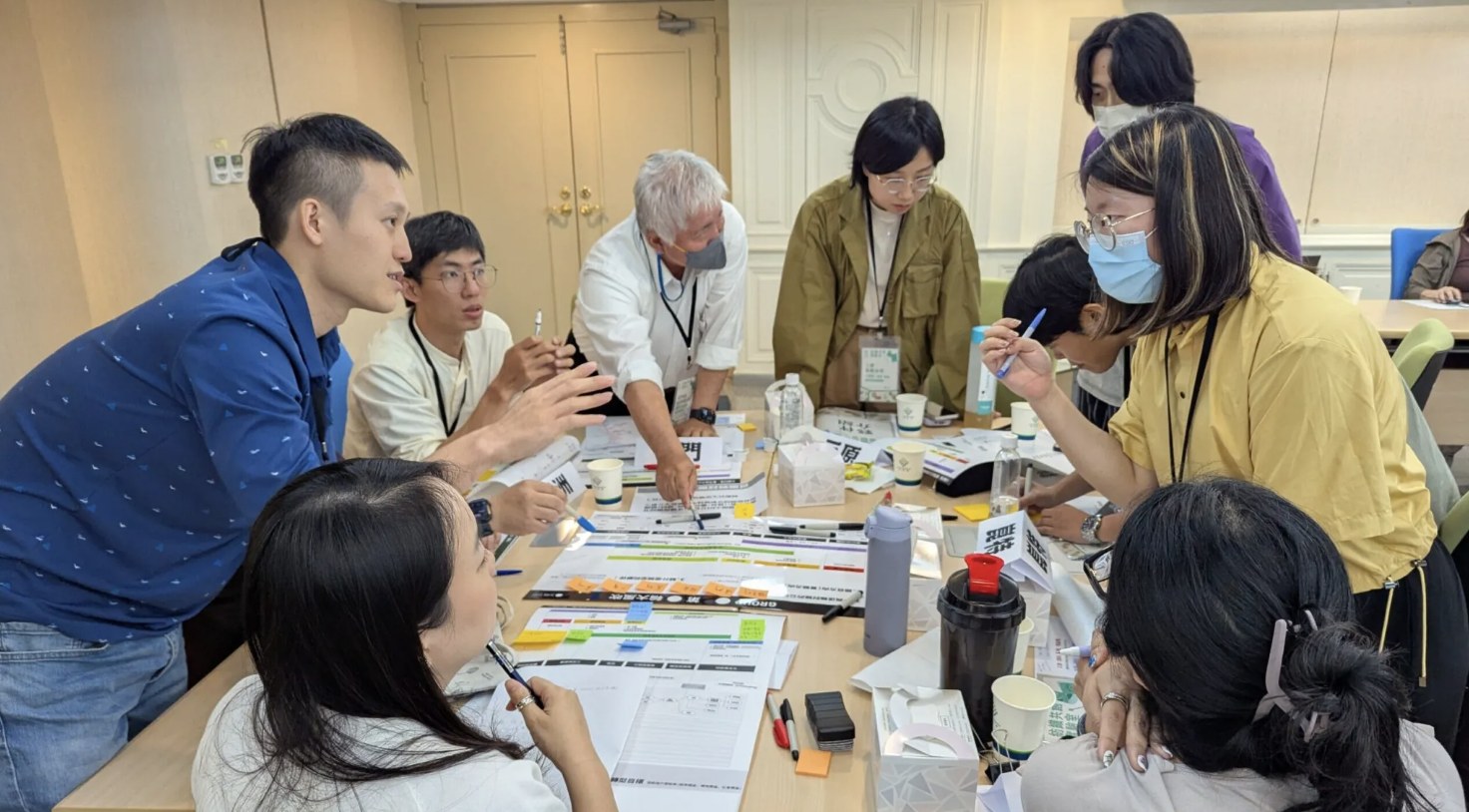
In 2019, Business Models Inc. Taiwan and the Taiwan Textile Research Institute launched the Textile Co-Creation Lab. Over eight years, more than 120 companies have joined. By bringing together partners from different fields and designing practical experiments, the Lab helps each company find its role in a circular value chain and turn ideas for collaboration into action.
The challenge
Many SMEs are already taking steps toward circularity. Saving energy and materials and recycling within their own operations have become part of everyday business. Some have ideas for circular materials, products or services. The harder part is often what comes next: testing those ideas, putting them into practice and scaling what works.
Changing material sources, designing for circularity, repurposing offcuts, selling recycled materials and offering rental services all involve more players. Companies need to know what they can contribute, which capabilities they lack and who can help. Together, those partners can design and run a first small-scale experiment.
Take a challenge identified by one group in the 2026 Textile Co-Creation Lab: turning offcuts into marketable products. The group brought together a DEI organization supporting women's empowerment, a bio-based dye producer, a recycled material supplier and a company integrating circular procurement and recycling management. Before joining the Lab, they did not know how their capabilities could complement one another. By connecting materials, technology, design and recovery management, they found the beginnings of a circular solution they could test further.
Over eight years, Lab partners have launched business model experiments across different circular economy pathways. They have explored recycled materials; digital and low-carbon design and production; cross-industry uses for resources; circular design across the product life cycle and product-as-a-service models; single-material products; natural fibers; and digital product passports. More than 30 topics have been discussed and tested. Examples include:
Textile-to-textile polyester sorting and pelletizing pilot | 2022+
Recyclers, sorting technology providers, fiber producers and fabric suppliers connected to test a textile-to-textile pathway. A sandbox experiment examined technical and regulatory feasibility and modeled how the partners could work together.
Digital fabric platform | 2023+
A digital fabric platform was developed to help designers and brands collaborate, shorten development cycles, reduce repeated sampling and bring products to market faster.
Turning textile offcuts into boiler fuel | 2023+
Partners explored processing textile offcuts and other waste into boiler fuel, testing a new use for materials otherwise discarded.
Turning surplus fabric into panels and upholstery | 2024+
Different circular pathways were explored according to fabric properties, including panels and furniture upholstery, alongside the potential for a rental service.
Digital product passports (DPP) | 2025+
As international rules continued to evolve, partners examined how fabric suppliers, garment makers, brands and resale services could connect product information. IT service providers joined the discussion to help shape potential solutions.
Single-material children's outdoor backpacks and circular rental | 2026+
Partners tested the durability and recyclability of a single-material children's outdoor backpack, alongside a circular rental and service model.
There is no single path to a circular economy. Companies can start with the challenges they face, find the right partners and use small experiments to turn an idea into a solution they can test.
Our approach
At the Textile Co-Creation Lab, BMI Taiwan helps companies turn circular challenges into experiments they can run. We start with three steps:
- Narrow the challenge to a scope that can be validated.
- Clarify each company's role, capability gaps and the partners it needs.
- Run a small-scale experiment first, then use the feedback to decide whether to invest further.
Using the Circular Transition Goals and Roadmap, we help participants explore opportunities in circular procurement, manufacturing, design, services and recycling management. Teams identify the assumptions they need to test, agree on each partner's role and design focused experiments that generate useful feedback. This helps companies test technical and market feasibility before changing their operations or committing significant capital.
The results
- More than 120 companies participated over eight years, starting in 2019.
- The Lab helped launch more than 30 cross-company collaboration projects.
- The Lab created a space for dialogue among manufacturers, brands, recyclers, technology providers, government agencies, verification bodies and industry experts.
- Companies clarified their roles, capability gaps and the partners they needed.
- Cross-disciplinary teams turned collaborative ideas into actionable small-scale experiments.
- Companies could begin their circular transition with small-scale experiments before making major process changes or capital investments.
- The co-creation network has expanded into furniture, ICT, outdoor education, social enterprise, bio-based dyes, chemicals and recycling equipment.
Want to explore how co-creation can help SMEs take their first steps toward circularity?
The method stayed with the team. It always does.
Want resultslike these?
Explore the possibilities with Patrick van der Pijl and the BMI team. Every big shift starts with a conversation.